Frogs of Australia
The frogs of Australia
Search for a frog
Taxonomy
Image archive
Glossary
Regional guides
New South Wales
Northern Territory
Queensland
South Australia
Tasmania
Victoria
Western Australia
Frogs of ...
New South Wales
Northern Territory
Queensland
South Australia
Tasmania
Victoria
Western Australia
Key guide to Victorian frogs
The Frogs of Victoria project is retained only for the great key guide. Work through a series of questions until, finally, your frog is identified.
Stay in touch
Get news from frogs.org.au with our mailing lists - you'll hear about upcoming events and changes to the website and much more. Manage your account to receive only the news that you want.
More to see

This website is part of the ARC group of sites at frogs.org.au.
Uperoleia laevigata
Smooth Toadlet
Also: Eastern Gungan
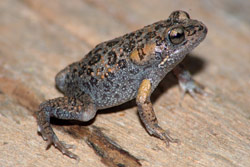
+ 41 kb Smooth Toadlet (Uperoleia laevigata)
A small to moderate species, this frog is common along the east coast from East Gippsland to southern Queensland.
Distribution and habitat

Adults are found in dry forest, woodlands, open and disturbed areas. Although most commonly found near water, they can be found in dry depressions that flood in winter or spring. Eggs and tadpoles are aquatic and found in ponds, lagoons, dams, lakes, and flooded grassland.
There is a detailed distribution map available for: Victoria.
Calling

Some files may require Macromedia Flash. The Flash plug-in is a free download and is available from the Macromedia website. If you experience problems, ensure that you have version 8.0 or greater.
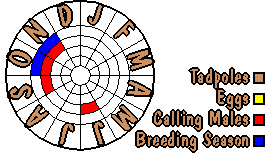
Males call from the ground or in low vegetation near water. The call is a long buzzing call - "eeeeeeeeeeeeep" - lasting about a second, and repeated every two to three seconds.
Copyright Murray Littlejohn. Recorded by Murray Littlejohn. Must not be reproduced without permission.
Life cycle
Distinguishing characteristics
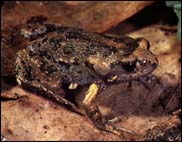 Adult
length: 20-35mm.
Adult
length: 20-35mm.
Eggs are pigmented and scattered, attached to submerged vegetation. The tadpoles are unknown. Adults have a large and well-developed parotoid gland, and red spots concealed in the groin and behind the knee. The belly is not fully pigmented.
Visible features
Presented here is the information stored in the frogs.org.au database which is used to identify frogs based on their appearance. It is intended to be used in a key guide for separating species so some of the information (for example, back colours) may be rather non-specific. The system is currently being developed - if you notice errors in the data, please write to Dave Black at the address at the bottom of the page.
Important note: This information details only the appearance of the frog. If an "or" appears in the description, this may mean either that there is some variation within the species or that the feature might be observed differently by different people. For example, if a frog has very small toe pads, it may be listed as having "Toe pads: present or absent".
Size
Up to between 30mm and 60mm
Eyes, hands, and feet
Pupils: horizontal
Toe pads: absent
Webbing on feet: no webbing
Belly
Texture: smooth
Pattern: marbled or peppered
Colour: multi-coloured featuring a colour in addition to black, grey, and white
Back
Texture: rough or warty
Pattern: plain or spotted or mixed / marbled
Colour: single colour or multi-coloured
Glands and tubercles
Parotoid gland: present
Tibial gland: absent
Metatarsal tubercles: Non-keratinised glands present (fleshy or uncoloured)
Similar species (note: this version was written for Victorian species).
Distinguished from most other species by the presence of its large well-developed parotoid glands, and from the other two Uperoleia species (Uperoleia martini and Uperoleia tyleri) by the belly not being fully pigmented and by the presence of a yellowish or light triangular patch on the head, the corners of which are the two upper eyelids and the tip of the nose. This species may be distinguished from Philoria frosti by having both inner and outer metatarsal tubercles.
The scientific names of Uperoleia laevigata
- Uperoleia marmorata laevigata (Keferstein 1867)
- Uperoleia laevigata (Keferstein 1867)