Frogs of Australia
The frogs of Australia
Search for a frog
Taxonomy
Image archive
Glossary
Regional guides
New South Wales
Northern Territory
Queensland
South Australia
Tasmania
Victoria
Western Australia
Frogs of ...
New South Wales
Northern Territory
Queensland
South Australia
Tasmania
Victoria
Western Australia
Key guide to Victorian frogs
The Frogs of Victoria project is retained only for the great key guide. Work through a series of questions until, finally, your frog is identified.
Stay in touch
Get news from frogs.org.au with our mailing lists - you'll hear about upcoming events and changes to the website and much more. Manage your account to receive only the news that you want.
More to see

This website is part of the ARC group of sites at frogs.org.au.
Philoria frosti
Baw Baw Frog
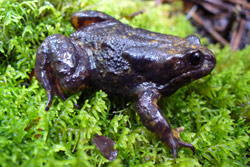
+ 65 kb Baw Baw Frog (Philoria frosti)
Victoria's most restricted frog, the Baw Baw frog is only found at high altitudes on the Mount Baw Baw Plateau in eastern Victoria. Inhabiting a restricted and fragile environment this frog is threatened by development and intense use of the Baw Baw Plateau for recreational and forestry activities.
Distribution and habitat

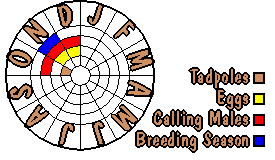
Adults had, until recently, been thought to be restricted to alpine heath and grassland. They have now been found within the moist eucalypt forests which border the Plateau. Tadpoles are aquatic, in alpine bogs and seepages. Eggs may be spawned in saturated sphagnum bogs that later flood.
There is a detailed distribution map available for: Victoria.
Calling

Some files may require Macromedia Flash. The Flash plug-in is a free download and is available from the Macromedia website. If you experience problems, ensure that you have version 8.0 or greater.
Males call from the ground, concealed in wet cavities in sphagnum moss, and under fallen debris. The call is quite variable, a series of harsh pulsing notes with the first note often the longest - "Aaaark kruk kruk kruk".
Copyright Murray Littlejohn. Recorded by Murray Littlejohn. Must not be reproduced without permission.
Life cycle
Distinguishing characteristics
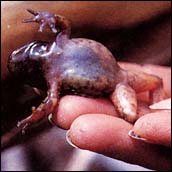 Adult
length: 42-55mm.
Adult
length: 42-55mm.
The unpigmented eggs numbering between 50 and 180 are spawned in a foam nest. Tadpoles carry large yolksacks and do not need to feed. They are also unpigmented with a yellow or pinkish appearance. Adults are characterised by having a large parotoid gland extending from behind each eye over the shoulder. They are dark and often have a highly pigmented smooth belly.
Similar species (note: this version was written for Victorian species).
Amongst Victorian frogs, only Uperoleia species have a large and well developed parotoid gland and the Baw Baw Frog may be distinguished from them by the absence of any metatarsal tubercles and by its larger size. Uperoleia have both an inner and outer metatarsal tubercle.
Philoria frosti image gallery


Eggs and egg masses (embryonic stage)

The scientific names of Philoria frosti
- Philoria frosti (Spencer 1901)